
care work

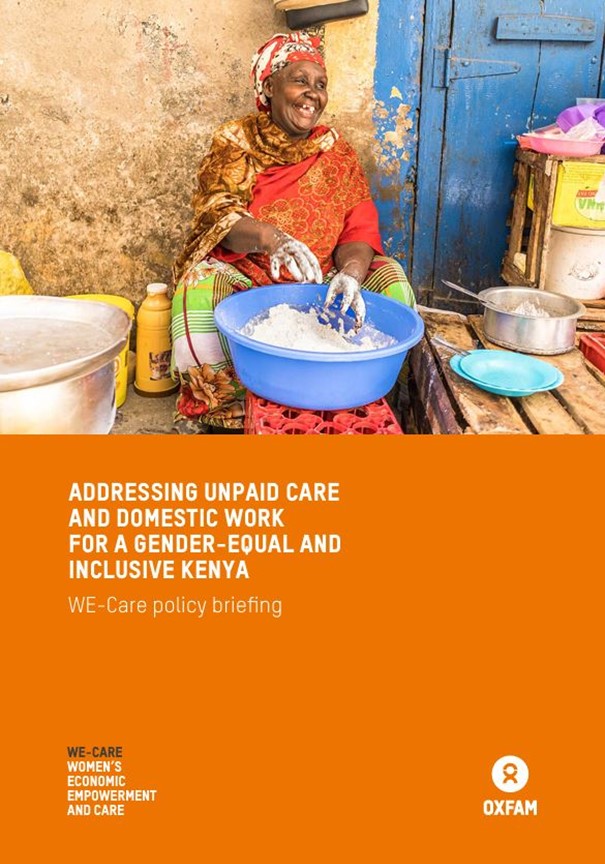
Addressing unpaid care and domestic work for a gender-equal and inclusive Kenya

April 13, 2021

This policy brief outlines why unpaid care work is a critical development, economic and gender equality issue for Kenya. It draws on two sets of evidence from Oxfam’s Women’s Economic Empowerment and Care (WE-Care) programme, which explore the impact of women and girls’ heavy and unequal unpaid care responsibilities both before and during COVID-19.
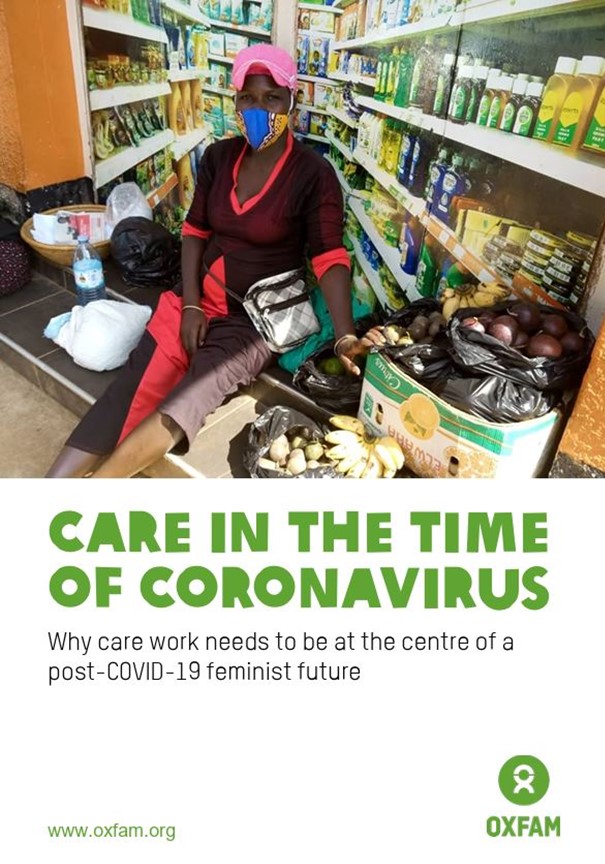
Care in the time of coronavirus: Why care work needs to be at the centre of a post-COVID-19 feminist future

June 25, 2020

New research by Oxfam and partners reveals that while COVID-19 and the related containment efforts have caused increases in women’s – and men’s – unpaid care workloads, women are still doing the bulk of this work.

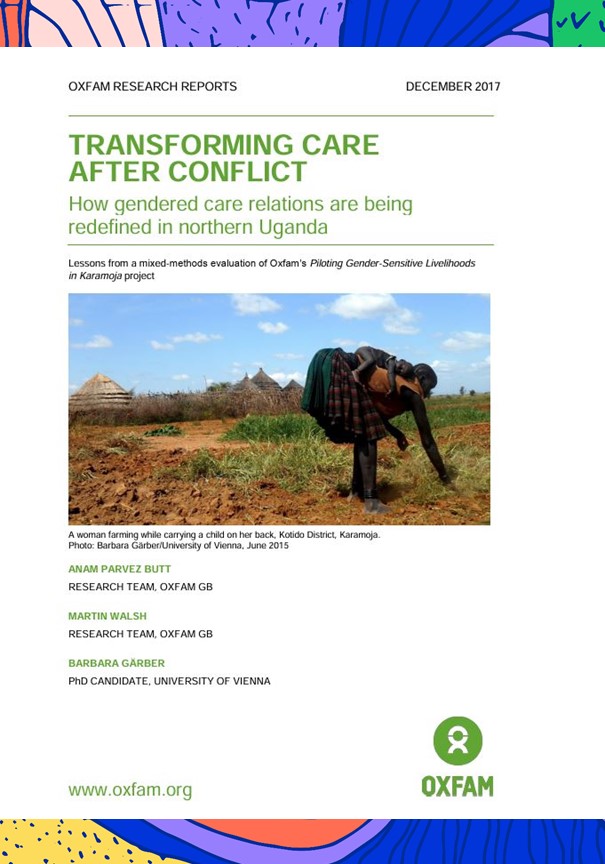
Transforming care after conflict: How gendered care relations are being redefined in northern Uganda

December 17, 2017

This report assesses two evaluations of the project: a quantitative impact evaluation, which found that its economic empowerment activities in Kotido had a positive impact for women overall; and a qualitative follow-up study designed to dig deeper into the findings about care work as part of Oxfam’s Women’s Economic Empowerment and Care initiative (WE-Care).

Women’s Economic Empowerment and Care: Phase 1 Final Report

November 2, 2016

The first phase of the WE-Care programme built on Oxfam’s previous experience with Rapid Care Analysis methodologies in livelihoods programmes. The programme aimed to complement and strengthen Oxfam’s initiatives on women’s leadership and livelihoods by building evidence for influencing change on care, while also providing the development sector with methods and knowledge to strengthen future advocacy on women’s economic empowerment and care work.

Market systems approaches to enabling women’s economic empowerment through addressing unpaid care work

March 5, 2016

The paper proposes that market systems programmes should, at a minimum, incorporate an understanding of care work into market analysis, to avoid unintended consequences and ensure that women as well as men benefit from interventions.

Women’s Economic Empowerment and Care: Evidence for influencing

July 20, 2015

To gain a clearer understanding of care work and pathways of change to promote more equitable care provision, Oxfam conducted a Household Care Survey in communities of rural Colombia, Ethiopia, the Philippines, Uganda and Zimbabwe. Data were collected on household characteristics, members’ time use, socioeconomic status, social norms, labour-saving equipment and public infrastructure.

Redistributing care work for gender equality and justice: A training curriculum

June 15, 2015

Designed for community facilitators working with illiterate or semi-literate groups, this training curriculum is intended for women and men to understand and challenge the conventional view of the economy by putting care for people and the environment first. It unpacks how power can be challenged at the household, community and state levels to recognize, reduce and redistribute women’s unpaid care work.

Oxfam’s WE-Care Initiative: An overview

May 20, 2015

Oxfam's 2014–2017 WE-Care initiative addressed the unequal burden of care and housework to improve outcomes for women in their food security, political participation, and other programs. Directly active in ten countries like Colombia and Uganda, aspects of WE-Care were also implemented in Bangladesh and Honduras through Oxfam Canada, GB, and Novib.