Household Care Survey

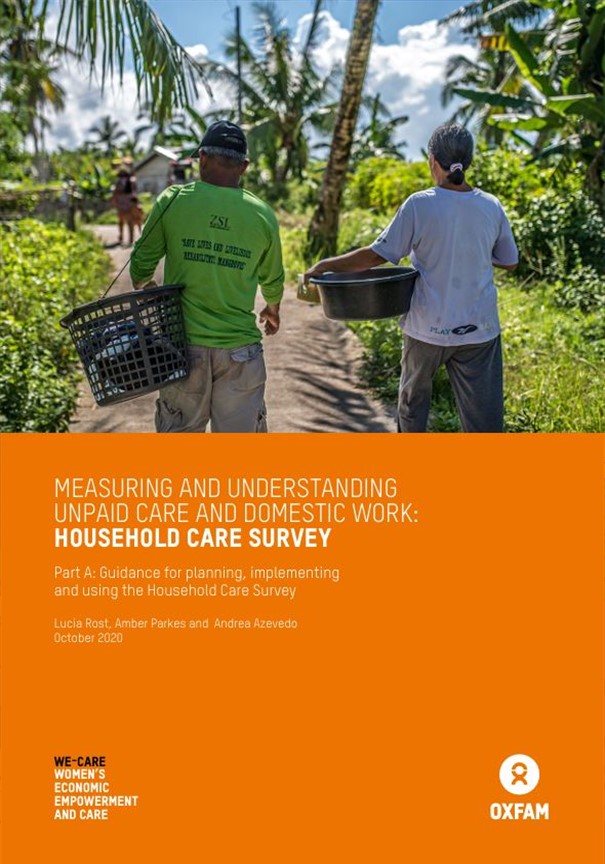
Measuring and understanding unpaid care and domestic work: Household Care Survey Toolkit

October 30, 2020

This toolkit provides guidance on using Oxfam’s Household Care Survey (HCS) methodology, which was developed by Oxfam as part of the WE-Care initiative to transform the provision of unpaid care and domestic work (UCDW).
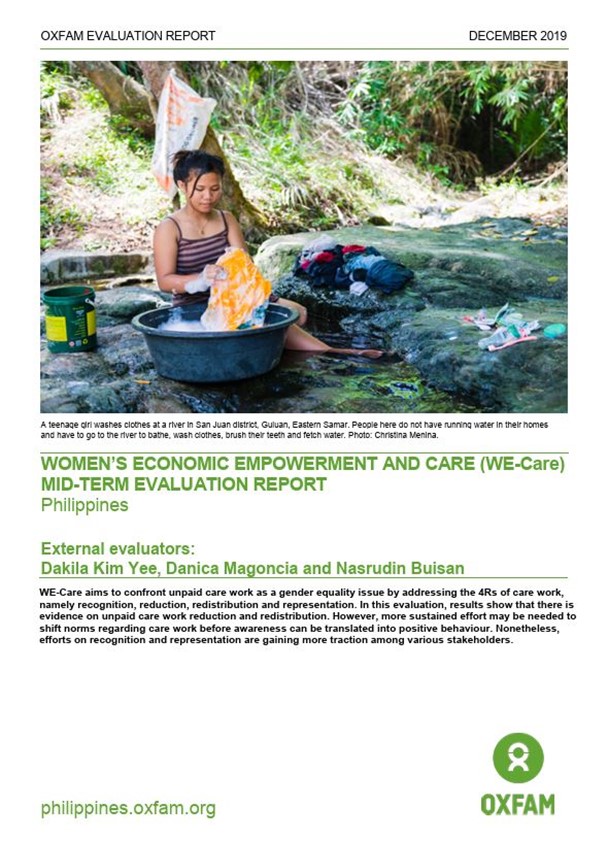
Women’s Economic Empowerment and Care Mid-Term Evaluation Report: Philippines

December 9, 2019

Overall, the evaluation finds that there is evidence unpaid care work is being reduced and redistributed. However, more sustained effort may be needed to shift social norms regarding who performs care work before awareness can be translated into positive behaviour. Nonetheless, efforts on recognition and representation are gaining more traction among people in the community.

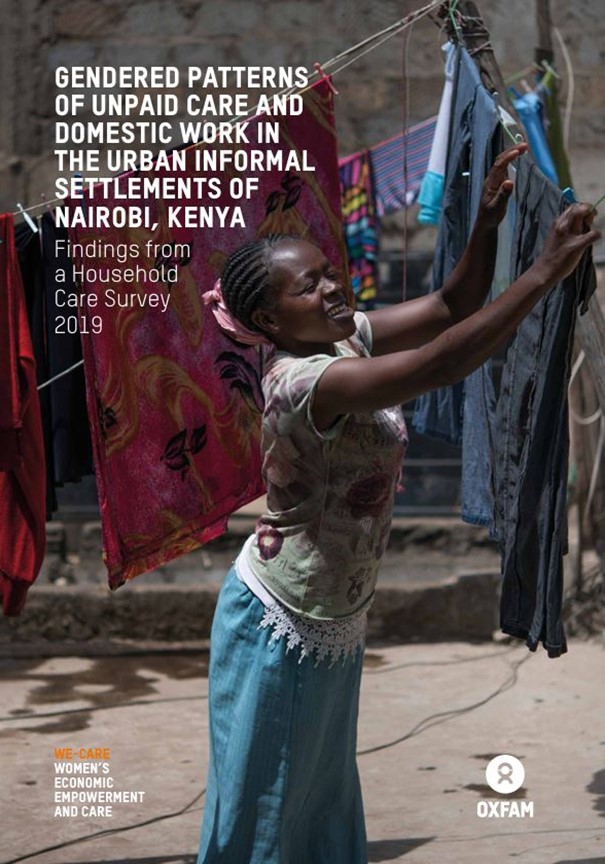
Gendered patterns of unpaid care and domestic work in the urban informal settlements of Nairobi, Kenya: Findings from a Household Care Survey in 2019

November 19, 2019

In 2018–2019, Oxfam's Women's Economic Empowerment and Care (WE-Care) programme conducted a Household Care Survey (HCS) in five informal settlements of Nairobi, Kenya, to understand the gendered patterns of unpaid care and domestic work across these communities.

Measuring unpaid care work in household surveys

June 6, 2018

This research case study discusses the successes and challenges of the time use measurements used in Oxfam’s Household Care Surveys. The surveys, supported by Oxfam’s Women’s Economic Empowerment and Care (WE-Care) programme, aimed to measure adults’ and children’s time spent on unpaid care work and other factors that could influence this distribution within the household.

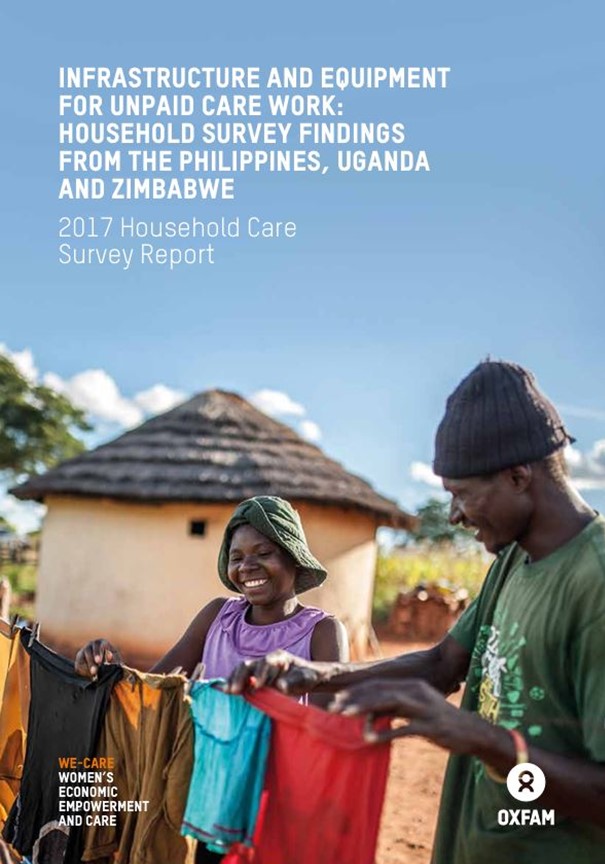
Infrastructure and equipment for unpaid care work: Household survey findings from the Philippines, Uganda, and Zimbabwe

March 26, 2018

In 2017, Oxfam’s Women’s Economic Empowerment and Care (WE-Care) initiative conducted a Household Care Survey (HCS), collecting data in the Philippines, Uganda and Zimbabwe, to inform the design of public policies and local development programmes. The study tests which infrastructure, equipment and other factors influence care-work patterns.

Factors and norms influencing unpaid care work: Household survey evidence from five rural communities in Colombia, Ethiopia, the Philippines, Uganda, and Zimbabwe

November 15, 2016

In order to address ‘heavy’ and ‘unequal’ care work and to raise the profile of care as a cross-cutting development issue, Oxfam and its partners implemented a baseline Household Care Survey (HCS) in five countries in which the WE-Care project was active.

Women’s Economic Empowerment and Care: Evidence for influencing

July 20, 2015

To gain a clearer understanding of care work and pathways of change to promote more equitable care provision, Oxfam conducted a Household Care Survey in communities of rural Colombia, Ethiopia, the Philippines, Uganda and Zimbabwe. Data were collected on household characteristics, members’ time use, socioeconomic status, social norms, labour-saving equipment and public infrastructure.