unpaid care and domestic work

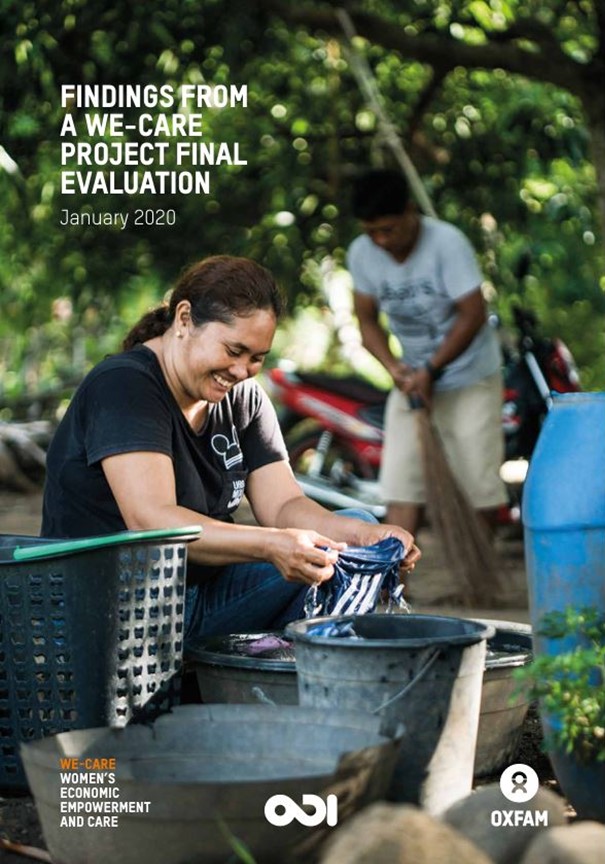
Findings from a WE-Care Project final evaluation

January 17, 2020

The evaluation findings show that in two years of implementation, the project was successful in reducing women’s time on care tasks and in promoting recognition of unpaid care in policies at local level. It also made considerable progress towards more gender-equitable distribution of care work, contributing towards shifting both norms and behaviour around unpaid care and domestic work.
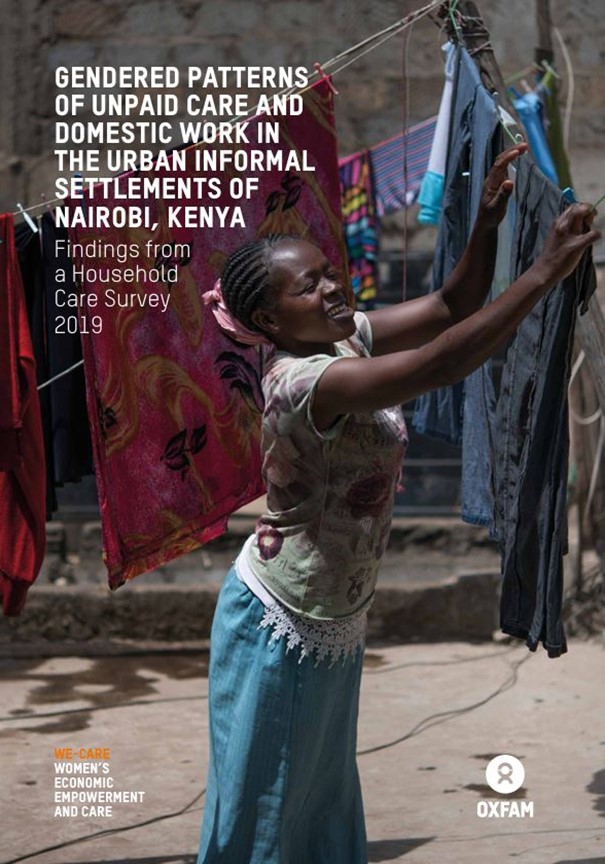
Gendered patterns of unpaid care and domestic work in the urban informal settlements of Nairobi, Kenya: Findings from a Household Care Survey in 2019

November 19, 2019

In 2018–2019, Oxfam's Women's Economic Empowerment and Care (WE-Care) programme conducted a Household Care Survey (HCS) in five informal settlements of Nairobi, Kenya, to understand the gendered patterns of unpaid care and domestic work across these communities.

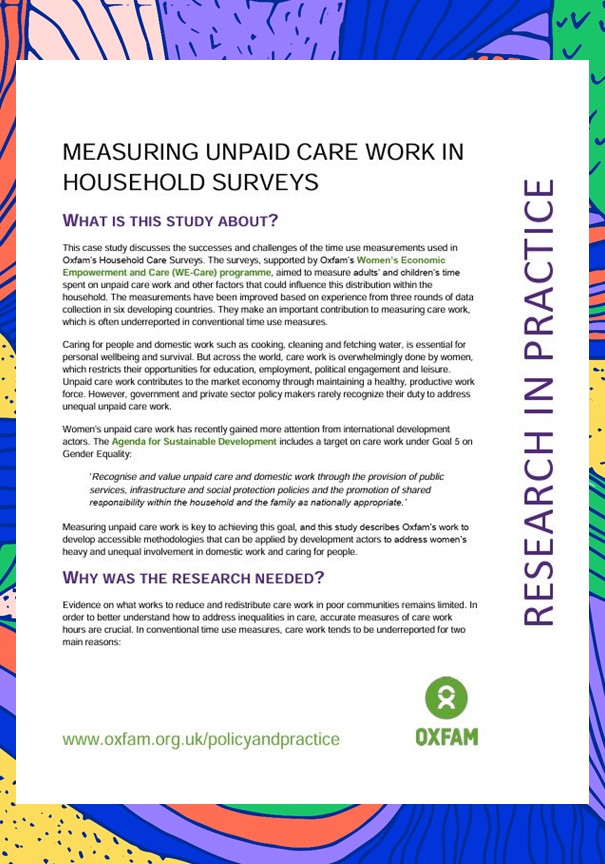
Measuring unpaid care work in household surveys

June 6, 2018

This research case study discusses the successes and challenges of the time use measurements used in Oxfam’s Household Care Surveys. The surveys, supported by Oxfam’s Women’s Economic Empowerment and Care (WE-Care) programme, aimed to measure adults’ and children’s time spent on unpaid care work and other factors that could influence this distribution within the household.

Rapid Care Analysis Training Modules

March 26, 2018

The Rapid Care Analysis (RCA) was designed to be a user-friendly assessment tool that development practitioners could learn through distance training sessions. The purpose of the RCA is to assess who in a community carries out unpaid care, so that where care work is heavy and unequal it can be recognized, reduced and redistributed, and so carers can be represented in decision making.

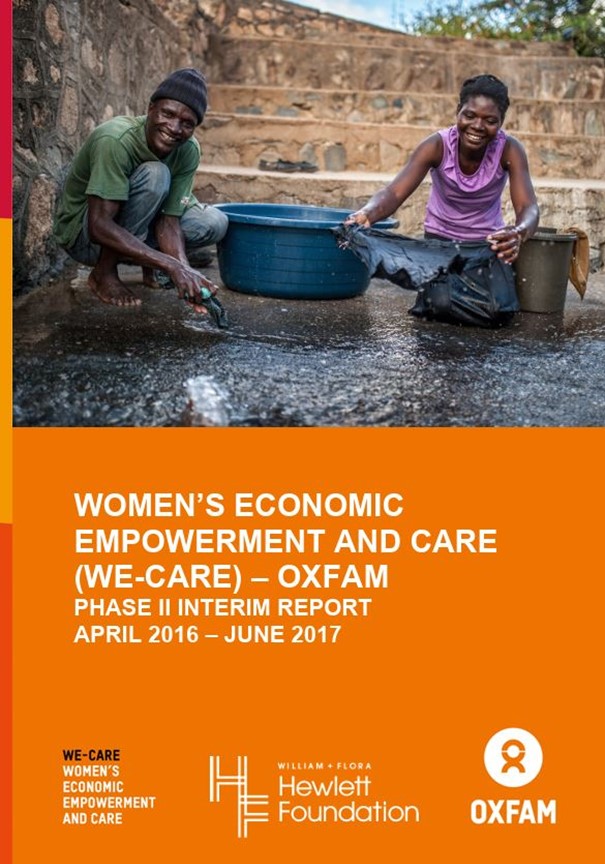
Women’s Economic Empowerment and Care: Phase II Interim Report

September 12, 2017

This report examines the second phase of Oxfam’s Women’s Economic Empowerment and Care (We-Care) programme. The first phase focused on building evidence for influencing policy change on women’s heavy and unequal unpaid care work in six countries.

Women’s Economic Empowerment and Care: Phase 1 Final Report

November 2, 2016

The first phase of the WE-Care programme built on Oxfam’s previous experience with Rapid Care Analysis methodologies in livelihoods programmes. The programme aimed to complement and strengthen Oxfam’s initiatives on women’s leadership and livelihoods by building evidence for influencing change on care, while also providing the development sector with methods and knowledge to strengthen future advocacy on women’s economic empowerment and care work.

Oxfam’s WE-Care Initiative: An overview

May 20, 2015

Oxfam's 2014–2017 WE-Care initiative addressed the unequal burden of care and housework to improve outcomes for women in their food security, political participation, and other programs. Directly active in ten countries like Colombia and Uganda, aspects of WE-Care were also implemented in Bangladesh and Honduras through Oxfam Canada, GB, and Novib.