
WE-Care

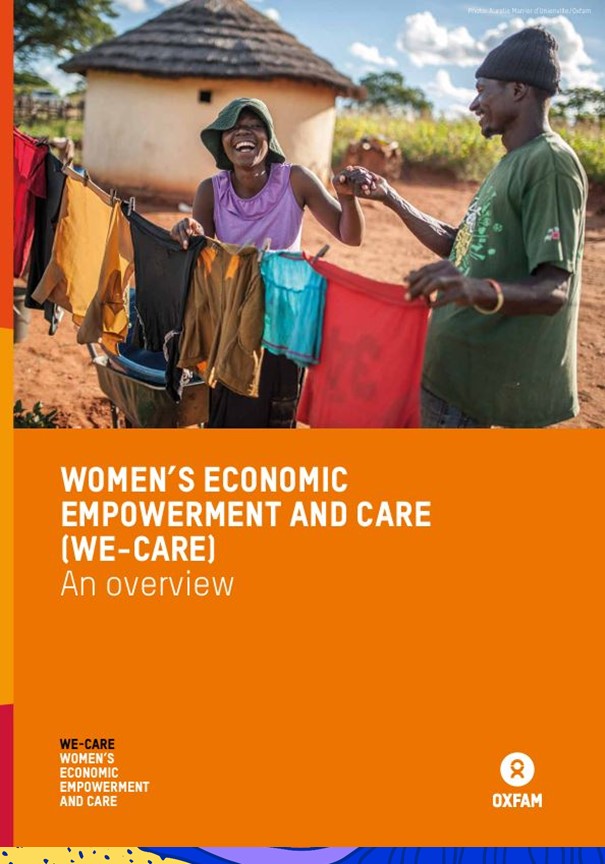
Women’s Economic Empowerment and Care (WE-Care): An overview

August 8, 2017

WE-Care was launched in 2014 in five countries – Colombia, Ethiopia, The Philippines, Uganda and Zimbabwe – and components of the approach are now being implemented across numerous Oxfam programmes covering livelihoods, health rights, women’s leadership and youth empowerment. 

Factors and norms influencing unpaid care work: Household survey evidence from five rural communities in Colombia, Ethiopia, the Philippines, Uganda, and Zimbabwe

November 15, 2016

In order to address ‘heavy’ and ‘unequal’ care work and to raise the profile of care as a cross-cutting development issue, Oxfam and its partners implemented a baseline Household Care Survey (HCS) in five countries in which the WE-Care project was active.

WE-Care Malawi Programme Report: Linking unpaid care work and mobile value-added services in Malawi

November 2, 2016

This report describes the use of information and communications technologies for data gathering, analysis and implementation of a randomized control trial. This aimed to understand the impact that access to Nutrition (Agri and Health) services had on the allocation of time to unpaid care work.

Women’s Economic Empowerment and Care: Phase 1 Final Report

November 2, 2016

The first phase of the WE-Care programme built on Oxfam’s previous experience with Rapid Care Analysis methodologies in livelihoods programmes. The programme aimed to complement and strengthen Oxfam’s initiatives on women’s leadership and livelihoods by building evidence for influencing change on care, while also providing the development sector with methods and knowledge to strengthen future advocacy on women’s economic empowerment and care work.

Women’s Economic Empowerment and Care: Evidence for influencing

July 20, 2015

To gain a clearer understanding of care work and pathways of change to promote more equitable care provision, Oxfam conducted a Household Care Survey in communities of rural Colombia, Ethiopia, the Philippines, Uganda and Zimbabwe. Data were collected on household characteristics, members’ time use, socioeconomic status, social norms, labour-saving equipment and public infrastructure.

Oxfam’s WE-Care Initiative: An overview

May 20, 2015

Oxfam's 2014–2017 WE-Care initiative addressed the unequal burden of care and housework to improve outcomes for women in their food security, political participation, and other programs. Directly active in ten countries like Colombia and Uganda, aspects of WE-Care were also implemented in Bangladesh and Honduras through Oxfam Canada, GB, and Novib.